Canine insight for archaeological and cultural resource work.
Dog Merickel provides specialized AHRDD support for archaeological projects, cultural resource investigations, cemetery work, and historic preservation efforts. Our dogs help identify areas of interest where human remains odor may be present, supporting better planning, documentation, and decision-making before ground disturbance occurs.
What We Support
Preliminary landscape assessment
Cemetery and burial location projects
Historic and cultural resource investigations
Avoidance-based project planning
Collaboration with archaeologists, CRM firms, Tribes, agencies, and landowners
Non-invasive search methods
How We Work
We approach every project with respect, discretion, and careful documentation. Each search is planned around the goals of the project, the landscape, access limits, cultural sensitivities, and the needs of the people responsible for the site.
A Valued Colleague
Janie Merickel has had the privilege of working alongside Melissa Kindt and Canines for Heritage Preservation on archaeological human remains detection dog projects. Together, we have supported archaeologists and cultural resource professionals through respectful, science-informed field investigations.
Learn more about Canines for Heritage Preservation - https://www.caninesforheritage.com/
For project inquiries, collaboration, or availability, please contact Dog Merickel:
Janie Merickel
(719) 839-8119
Is is a cheeseburger?
Is it a Cheeseburger?
What our dogs show us—and what we think we see
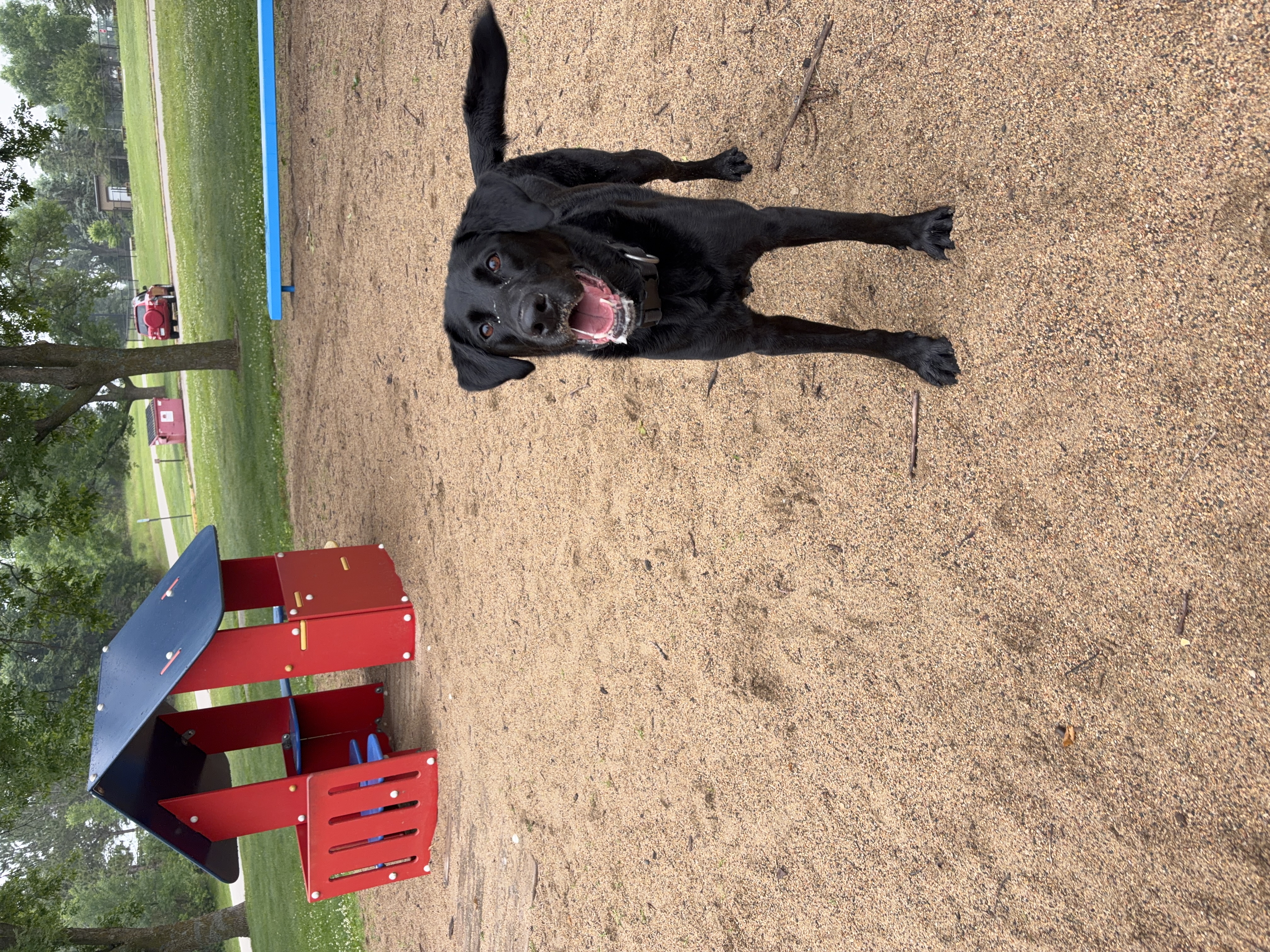
It is so easy to believe we know the signs of odor indication.
Why wouldn’t we? We have studied Dr. Steve MacKenzie’s eight signs of odor indication. We have watched Steve White’s 1000 Hour Eyes. We know to look at motion pull, nose height, tail carriage, breathing, cadence, circling, crabbing and head swing. Some of us have even made little cheat sheets to keep in our notebooks and training bags. I love those tools. I use them. They matter.
Maybe they also feel comforting because we want reading our dogs to be easy. Black and white feels much better than the gray world we actually work in. I get that. I live there, too.
But a change of behavior tells us that something changed. It does not necessarily tell us what changed.
A change of behavior is information. It is not automatically the answer.
The Video Challenge keeps us honest
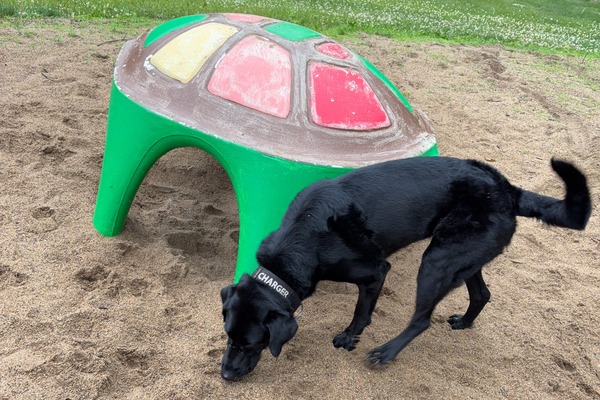
A few times a year, I run something we call the Video Challenge. Handlers submit short videos of their dogs working. At least one video shows the dog working target odor. Another shows the dog encountering a good non-target distraction—a cheeseburger, a beloved toy or another compelling odor.
The handler stops the video before the final response or before the dog moves away. The rest of us watch without knowing the ending.
We slow it down. We watch it again. We make a call: target or non-target? How confident are we? Would we act on what we just saw?
Then we watch the reveal.
And here is the humbling part: we are wrong a bunch. We don’t like it, either.
It is surprisingly easy to feel certain while watching 20 seconds of someone else’s dog. The more useful question may be what made us feel certain—and whether the dog actually gave us that information.
Why the cheeseburger matters
A dog may turn, slow, investigate, double back or increase intensity around target odor. That same dog may show remarkably similar behavior around food, a beloved toy, or something unusual in the environment.
Many of those changes of behavior can look the same.
That does not mean the dog is wrong. The dog may be reporting, quite accurately, “Hey, something changed here.” Our challenge is understanding what that behavior does—and does not—tell us.
This is why I like the cheeseburger. It gives the dog a real reason to change behavior, and it gives us a reason to stop treating every interesting movement as confirmation of target odor.
The eight signs help us look more carefully. They give us a way to study our dogs and begin building a database of what each individual dog looks like in odor, out of odor, around a distraction, when tired or when the problem changes.
They do not make every dog look the same, and they do not give every movement the same meaning. They help us notice how this dog changes.
“Oh, I can tell”
Whenever I talk about this, I hear from handlers—including really good handlers—who say, “Oh, I can tell.”
Honestly, I hope they can. What I suspect, though, is that certainty often arrives once the dog gives the trained final response. That is exactly what we need: a bombproof alert that clearly reports what the dog has decided.
But what happens before that final response?
If I decide an early change of behavior means target odor, I may begin helping my dog get there without realizing it. I may slow down, do the little two-step or cha-cha, drop or shorten the leash, turn toward the dog, move closer or simply stop and wait for the response I now expect.
Meanwhile, my dog reads my body language better than I read hers.
The question is not whether handlers influence dogs. Of course we do; we are a team. The question is whether our influence allows the dog to complete the investigation—or quietly encourages the answer we have already chosen.
We have to wait for the bomber alert.
What the new science adds
A new paper, Predicting Missed Alerts in Detection Dogs, by Jörg Schultz, Liza Rothkoff, Edgar O. Aviles-Rosa, Nathaniel J. Hall and Michele N. Maughan, asks a related question from a different direction: Can changes in a dog’s movement and physical state help predict a miss before it happens?
The researchers studied four trained detection dogs on a treadmill with precisely timed odor delivery. They examined the 4.5 seconds before the odor arrived and found that movement alone could predict an upcoming miss better than chance. Adding heart and temperature information improved the model’s ability to identify misses.
The most useful movement information came from the dog’s head, neck, spine and tail—not primarily from the legs. The changes were subtle. The dogs continued trotting without appearing to fall apart or become obviously tired.
I am not a scientist. I know and love some of the scientists who do this work, and I do not want to make the study say more than it does. It involved only four dogs in a controlled setting, not operational searches. Still, I find the possibility fascinating: useful information may be present in the dog before we understand what it means.
The study and our Video Challenge are not asking exactly the same question. The challenge asks whether handlers can distinguish behavior around target odor from behavior around a cheeseburger. The study asks whether movement and physiology can predict a coming miss.
But both lead me to wonder how much our dogs are already showing us—and how much we still have to learn about seeing it.
Could technology help us see more?
It is hard not to wonder whether computers and AI could help us learn more from the videos we are already studying.
Could technology compare hundreds of clips and show us patterns we have missed? Could it help us separate target trials from cheeseburger trials? Could it show us what tends to happen before a miss, a false alert or a fast, clean response?
Maybe it could also help us study ourselves. What did the handler do immediately after the dog changed behavior? Did we slow down, shorten the leash or stop moving? Did the dog’s behavior change again after we did?
I do not know exactly what AI can do here yet. But perhaps it could help us examine our videos more precisely and make better decisions about how we train. That seems worth exploring.
What do we owe our great dogs?
We can already make our video work more useful. We can include valued non-target odors, run blank searches and create problems where the handler genuinely does not know the answer. We can describe what we observe before deciding what it means. We can record our confidence before the reveal and pay attention to what the handler does after the first change of behavior.
Most of all, we can build a database of our own dog. Learn what target looks like. Learn what cheeseburger looks like. Learn what fatigue, frustration and novelty look like.
Our dogs may honestly show us that something in the environment matters. Sometimes it is the target odor we are looking for. Sometimes it is a cheeseburger.
I don’t think the answer is to distrust what we see. I think it is to keep getting better at seeing—and to stay humble about what either half of the team might miss.
Here’s something worth wondering about: When your dog changes behavior, what do you actually know—and what might you be adding to the story? What changes are you missing, and could your dog be missing something, too?
Here’s to the dogs who keep us honest, and the questions that keep us learning.
Janie

Frequently Asked Questions
GENERAL QUESTIONS
What is Dog Merickel?
Dog Merickel is a science-driven platform dedicated to advancing detection dog training through expert guidance, innovative tools, and a strong Community of Handlers.
Who is Dog Merickel for?
We support detection dog Handlers at all levels—whether you’re just starting out or refining advanced skills in Human Remains Detection (HRD) or Archaeology Human Remains Detection (AHRD).
What makes Dog Merickel different?
We combine cutting-edge science, structured training strategies, and a supportive online Community to ensure you and your dog reach the highest level of success.
The Society For Dogs
What is The Society For Dogs?
The Society For Dogs is our exclusive membership-based Community where Handlers can connect, learn, and grow together. We host weekly Coffee Chats, provide structured training discussions, and offer expert insights.
How do I join The Society For Dogs?
You can become a member by signing up on our website. Elite Memberships are currently $25 per month, but the price will increase soon!
What do I get as a member?
Access to our private online Community
Weekly live training discussions via Zoom
Structured training support and expert insights
Exclusive training resources and tools
Training and Courses
What is OdorQuest?
OdorQuest is our structured training program designed to take Handlers through progressive, science-backed detection training, helping teams build strong skills from foundational to advanced levels.
Can I buy training plans without joining The Society For Dogs?
Yes! We offer one-time training plans like Odor Origins that you can purchase individually. However, joining The Society gives you ongoing support, deeper insights, and access to live discussions.
Business & Logistics
Is Dog Merickel a nonprofit?
We are in the process of setting up a 501(c)(3) nonprofit called the Detection Dog Foundation, which will serve as the fundraising arm for scholarships and educational opportunities.
Do you offer in-person training?
We don’t provide hands-on field training, but we do guide Handlers in preparing for it. We also share insights on where to find the best field trainers and workshops.
Can I teach a course through Dog Merickel?
Yes! Our upcoming OdorQuest Academy will allow experienced Handlers to create and teach virtual classes, earning revenue while contributing to the growth of the detection dog Community.
Get in touch with us
Got questions? Fired up about training? Just want to talk dogs? We’re here for it.
At Dog Merickel, we don’t do cookie-cutter solutions—we craft strategies that work for YOU and your detection dog. Whether you're curious about The Society For Dogs, need a solid training plan, or just want to chat about the latest science in detection training, we’re all ears (and so are our dogs).
Email: [email protected]
- Monday - Friday, 8:00 am - 5:00 pm
Join the Conversation: The real magic happens inside The Society For Dogs—grab your spot here!
Drop us a message, and let’s make things happen.
Follow Us
Follow Us
Every sniff has a purpose. Every step has a strategy. Dog Merickel – Where Handlers and dogs crush goals together.
Services
More
© Copyright 2026 Dog Merickel. All rights reserved.